Approach and Methods to Appraise the Meaning of Verses in Quran

Meaning of Words and Verses

In any language, what is being conveyed in both speech and writing by the speaker or writer can only be understood if the meanings of words are shared through a convention. In speech much depends on the sound and tone of the voice. In writing the use a standardized spelling is necessary.

An Arabic word may have a range of meanings depending on context. It may be variations (nuances) related to the same meaning or a different meaning altogether. Which meaning an author decides to use depends on what idea or information he/she intends to convey. The reader must discern the context in which the idea is delivered. This requires the reader to read and understand the sentence where the word is used and also the information given by the author by in other sentences that surround it.

Therefore, when writing a narrative (letter, article or book), the author may apply:

  1. the same meaning to a word throughout
  2. give different meanings to the word when using it at different places

Meanings in Current Translations vs Possible Meanings

In reappraising the meaning of the Quran, I am compelled to examine alternative meanings of all words to see if they contribute to a more appropriate and fitting interpretation. Instead of assuming the meanings as used in the current understanding and practice (syariat) of Islam, I choose to look at meanings of words as used before as well as with the advent of Islam. An Arabic word may have a range of meanings depending on context. These may be variations (nuances) related to the same meaning or a different meaning altogether.

Meanings Taken by Traditional Translators

Currently there are many resources that provides meanings of verses by various translators. At the same time, some discusses the Arabic grammar, syntax and morphology for each word in the Holy Quran. The sites that I chose to use are:

Both resources use different approaches to provide the following functions:

  1. provides meanings of verses by various translators
  2. separate the verse into individual words
  3. identify root letters of the word
  4. assign the grammar to the word
  5. give the sites own literal meaning to each word
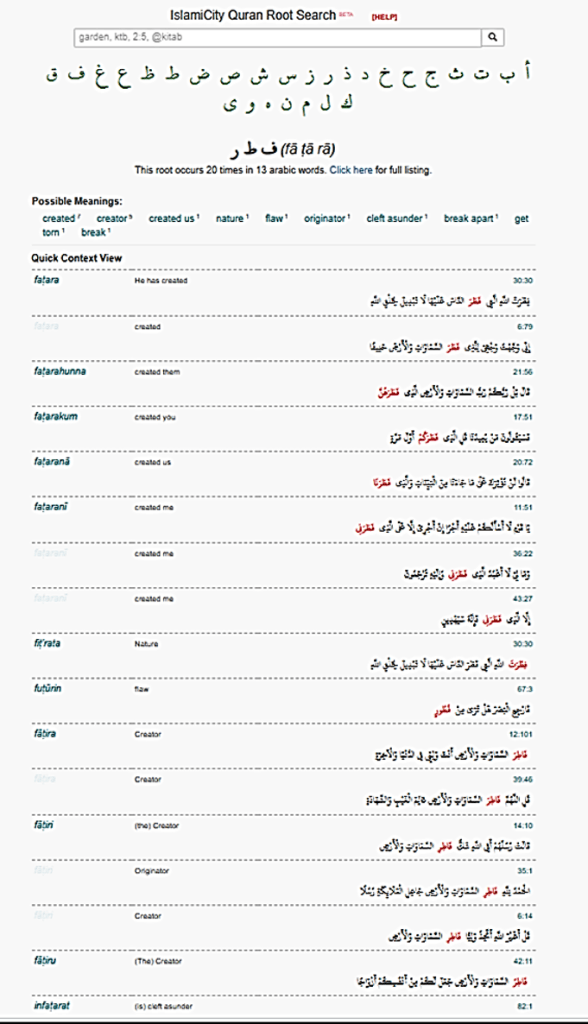
  6. list out words arising from the same root letters

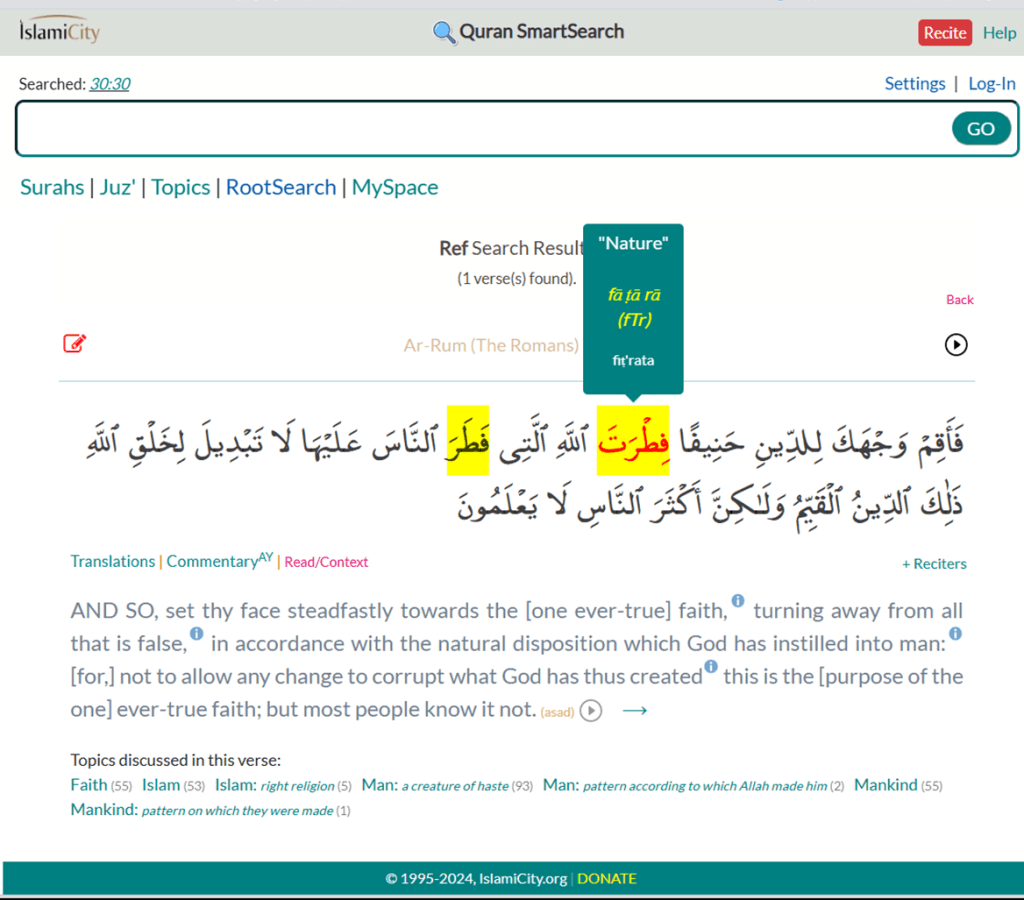
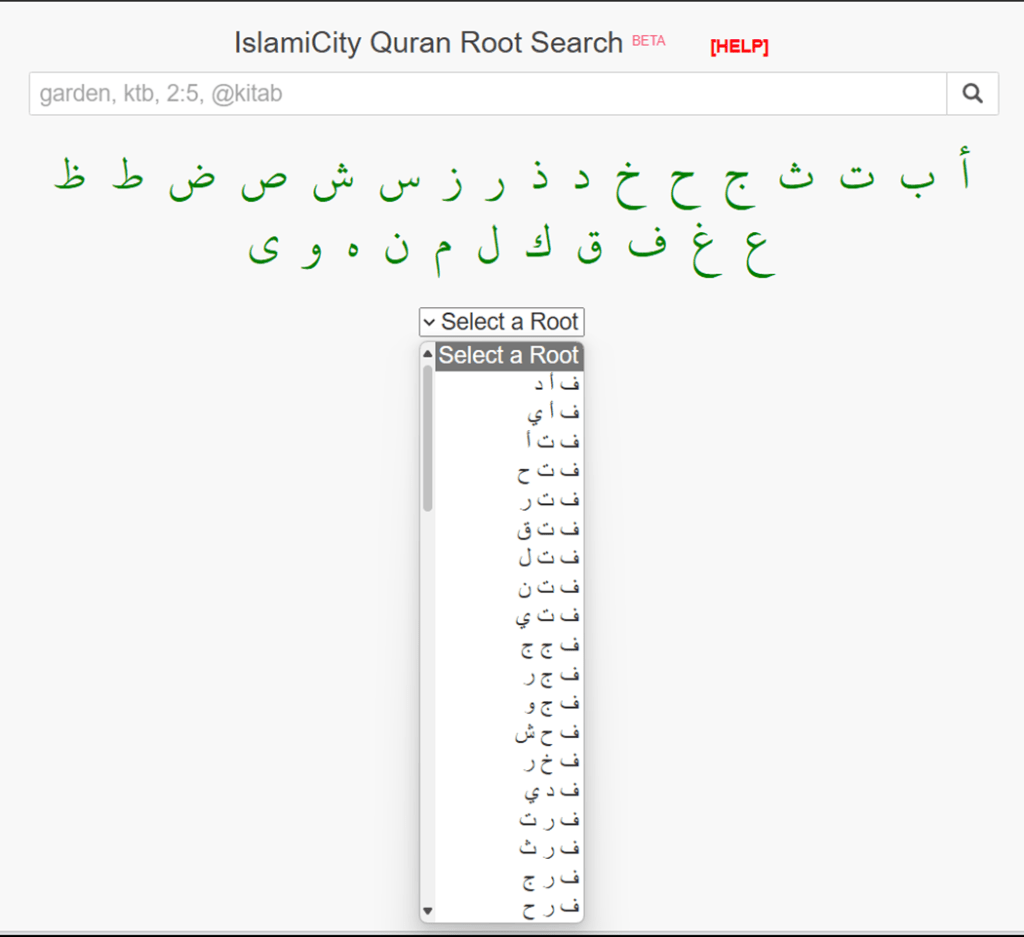
The print-screen images below provide a glimpse of the various functions.

Images From Corpus.quran Website

Corpus.quran Translations
Word For Word Meaning as Given by CorpusQuran.com
Identification of Root Letters of Words

Corpus.quran through its Quran dictionary also allows me to locate all verses where words derived from a root word occurs. Based on this, a person can see words derived from the same root letters have the same or different meanings when used elsewhere in the Quran. Since the surah and verse is known, the context within which the word is used can also be known.

Corpus.quran Verses Containingg Words Derived from the Same Root Letters

Images From IslamCity.org Website

IsalmCity Translations

The IslamCity Website gives an easy way to search verses by surah and ayat.
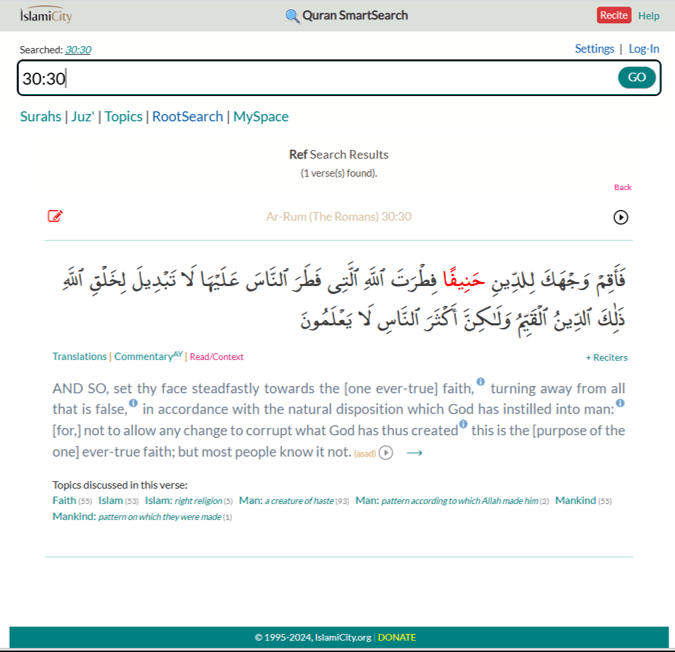
IslamCity Search for Verses
IsalamCity Word Study
IslamCity Root Search
IslamCity List of Verses Containing Words from Same Root Letters

Seeking Alternative Meanings

Reappraisal of The Meaning of the Quran

In trying to understand the content of the Quran, I would like to reappraise the meanings of various verses because I am not quite happy with existing translations and interpretations. I believe meanings given to the verses of the Quran are often not compatible with the fundamental principles of the deen (الدِّينِ) as I understand it and so endeavor to seek the actual understanding of them. My main objective is to find out what is it I am unhappy with. From there I hope to discover alternative meanings or interpretations that are more satisfactory. Therefore, I am writing in the first-person singular. On occasion when I write in first person plural, I am assuming that there are persons of kindred spirit making the journey with me. Yet, there is no escaping from the fact that I am a born Muslim who have known and use existing interpretations and translations of the Quran. At the same time, having lived through the 50s-70s, my world view is influenced by modernist thinking of that era and earlier. Hence, I would take advantage of this reality as I try to discern meanings afresh.

A translation of the Quran must arise from an interpretation of it. So not only must the words be converted but the syntax should be transformed. Translators in English often depend on traditional interpreters such as Al-Tabari and Ibn Kathir which they consider as reliable sources. There is a thinking that words have inherent (harfiah حرفي) meanings but in the context of religion (shariah شَرِيعَة ) they have special meanings. Any re-interpretation is considered as a deviation from Islam. I have a feeling that each new translator vary the way they translate for the sake of readability (ease of understanding) rather than making a re-interpretation. This leads to the tendency for them to be affected by confirmation bias. Despite this, I would like to look out for probable substantial differences in the increasing number of translations in English.

In this discussion, I attempt to weigh the differences in interpretation made by a sample of translators in English. I hope to examine and discuss the meaning given by the translators to various verses, phrases and words. I hope to discover whether the meanings given are based on presumptions, rather than reflect the true message expounded by the Quran. For this reason, I must give priority to deriving the meanings of verse related to الدِّينِ, (addeen), عْبُدُ (abd) and الصَّلَاةَ (assalah). An understanding of these terms should be the guide for the understanding of the rest of the Quran. These terms together with rlated terms such as الْهُدٰۤى (alhuda), (sunatullah), (siratul mustaqim) and (fi sabilillah) are related as part of a continuum. As such, I must examine each and eveyone of them to understand the whole. In this article I am concentrating on the meaning of one of them i.e., الصَّلَاةَ. I choose to examine alternative meanings of key words to see if they contribute to a more appropriate and fitting interpretation. For me, it is better to look at meanings of words as used before and during the advent of Islam. Lane’s Lexicon satisfies this need. I must be careful though that despite Lane’s attempt at finding meanings of words before the advent of Islam, all of the lexicons or dictionaries he quoted were written after the advent of Islam, even if the original literature and other sources were pre-Islamic.
My attitude is to examine the words of the Quran as they stand and try to derive the principles of the deen from them. I hope a re-examination of the meanings given to each and every word will help me arrive at my own conviction regarding the deen.

I will try hard to attempt to understand the meaning of words and sentences without making prior assumptions. In his way, I hope to tease out from the elements contained in various verses and use them to construct the concepts of the deen i.e. how best to live a life in the service of Allah. There are a multitude of verses containing words derived from the root word صَلِّى. It would be difficult to look closely at all of them. So, at the moment I will look at representative samples. I have decided to begin with the rudimentary words closest to the root word and subsequently move on to those with qualifiers. This choice is arbitrary, but I hope to group and rearrange verses in a more logical manner later.

For each verse, I will try to structure the discussion in the following sequence

  1. A critical appraisal of the traditional translations
  2. A re-look at meaning of verses by re-examining the principal words within them
  3. The lessons I have learnt from the exercise