I am a retired surgeon, currently offering consultancy services in Information Management in Health Care Services.
My interests and experience have been in patient care, quality management, clinical governance, medical education and information management (among other things).
I served as a doctor in primary, secondary and tertiary care with the Ministry of Health Malaysia from 1977 to 2011.
I am a life member of the Malaysian Society for Quality in Health, Malaysia; a society I helped establish and served as a Hospital Accreditation surveyor for many years.
I served as invited lecturer and taught undergraduate and postgraduate students at various medical faculties (UITM, UKM and USM) in Malaysia.
At Hospital Selayang, Malaysia, I was Chairman of the Clinical Advisory Committee, the Clinical-IT Coordinator and Quality Coordinator, for close to 10 years. I helped implement computerized hospital information systems in several hospitals.
I graduated with MBBS from University of Malaya in 1977. I was (but has since ceased to be) a fellow by examination of RCS Edinburgh and RCPS Glasgow.
I am contactable by e-mail at: drdollah@gmail.com
In any language, what is being conveyed in both speech and writing by the speaker or writer can only be understood if the meanings of words are shared through a convention. In speech much depends on the sound and tone of the voice. In writing the use a standardized spelling is necessary.
An Arabic word may have a range of meanings depending on context. It may be variations (nuances) related to the same meaning or a different meaning altogether. Which meaning an author decides to use depends on what idea or information he/she intends to convey. The reader must discern the context in which the idea is delivered. This requires the reader to read and understand the sentence where the word is used and also the information given by the author by in other sentences that surround it.
Therefore, when writing a narrative (letter, article or book), the author may apply:
the same meaning to a word throughout
give different meanings to the word when using it at different places
Meanings in Current Translations vs Possible Meanings
In reappraising the meaning of the Quran, I am compelled to examine alternative meanings of all words to see if they contribute to a more appropriate and fitting interpretation. Instead of assuming the meanings as used in the current understanding and practice (syariat) of Islam, I choose to look at meanings of words as used before as well as with the advent of Islam. An Arabic word may have a range of meanings depending on context. These may be variations (nuances) related to the same meaning or a different meaning altogether.
Meanings Taken by Traditional Translators
Currently there are many resources that provides meanings of verses by various translators. At the same time, some discusses the Arabic grammar, syntax and morphology for each word in the Holy Quran. The sites that I chose to use are:
Both resources use different approaches to provide the following functions:
provides meanings of verses by various translators
separate the verse into individual words
identify root letters of the word
assign the grammar to the word
give the sites own literal meaning to each word
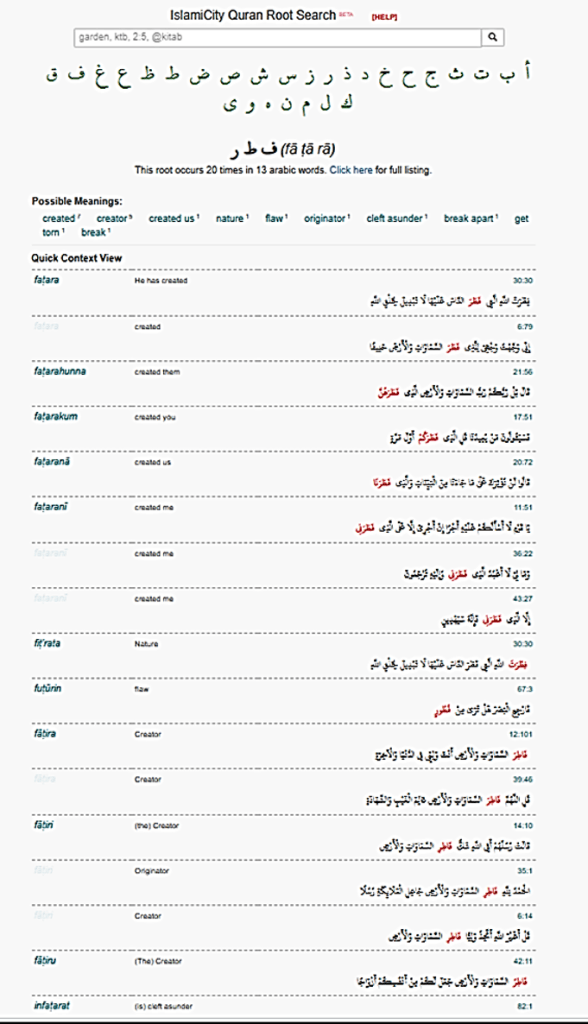
list out words arising from the same root letters
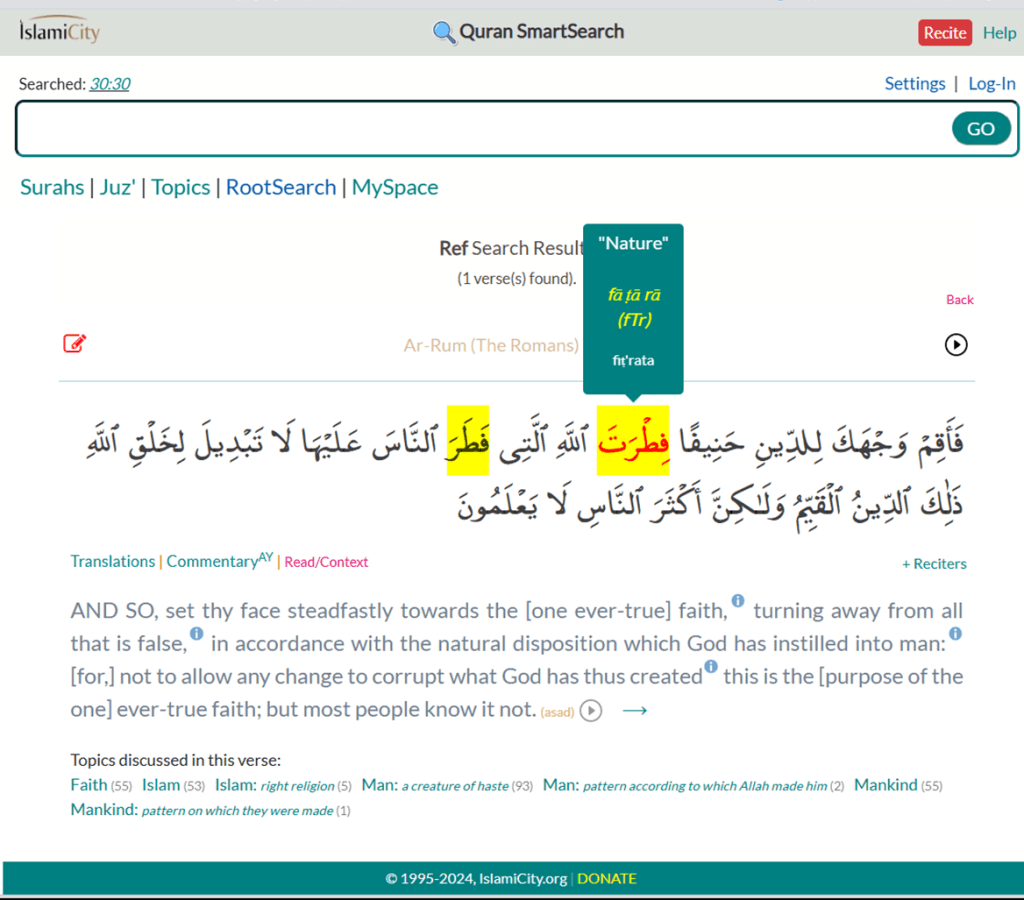
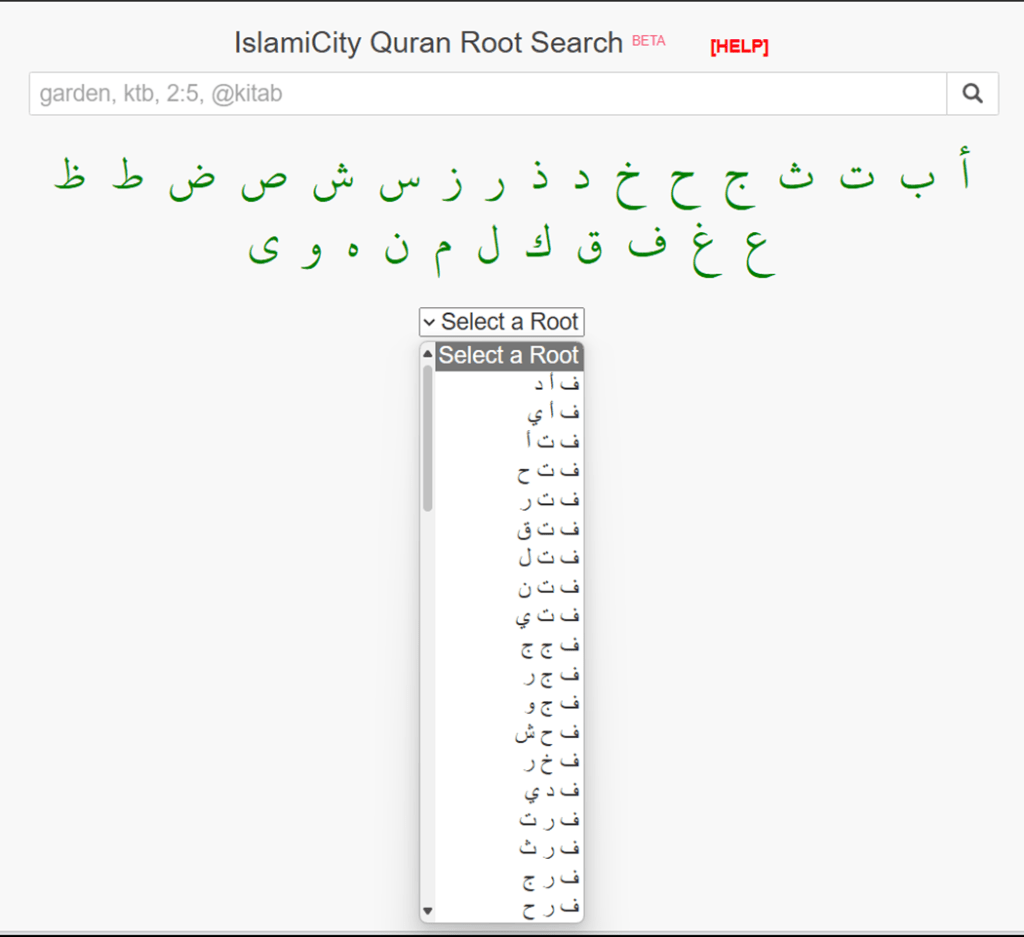
The print-screen images below provide a glimpse of the various functions.
Images From Corpus.quran Website
Corpus.quran TranslationsWord For Word Meaning as Given by CorpusQuran.comIdentification of Root Letters of Words
Corpus.quran through its Quran dictionary also allows me to locate all verses where words derived from a root word occurs. Based on this, a person can see words derived from the same root letters have the same or different meanings when used elsewhere in the Quran. Since the surah and verse is known, the context within which the word is used can also be known.
Corpus.quran Verses Containingg Words Derived from the Same Root Letters
Images From IslamCity.org Website
IsalmCity Translations
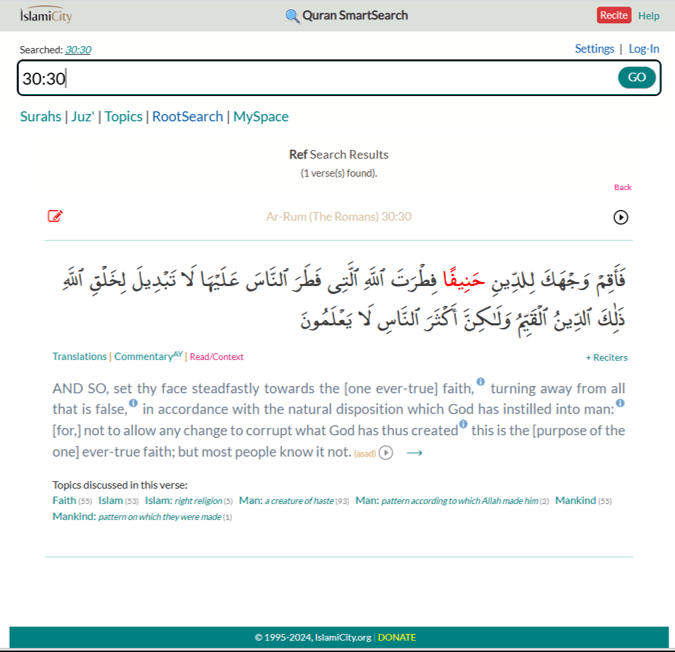
The IslamCity Website gives an easy way to search verses by surah and ayat.
IslamCity Search for VersesIsalamCity Word StudyIslamCity Root SearchIslamCity List of Verses Containing Words from Same Root Letters
In trying to understand the content of the Quran, I would like to reappraise the meanings of various verses because I am not quite happy with existing translations and interpretations. I believe meanings given to the verses of the Quran are often not compatible with the fundamental principles of the deen (الدِّينِ) as I understand it and so endeavor to seek the actual understanding of them. My main objective is to find out what is it I am unhappy with. From there I hope to discover alternative meanings or interpretations that are more satisfactory. Therefore, I am writing in the first-person singular. On occasion when I write in first person plural, I am assuming that there are persons of kindred spirit making the journey with me. Yet, there is no escaping from the fact that I am a born Muslim who have known and use existing interpretations and translations of the Quran. At the same time, having lived through the 50s-70s, my world view is influenced by modernist thinking of that era and earlier. Hence, I would take advantage of this reality as I try to discern meanings afresh.
A translation of the Quran must arise from an interpretation of it. So not only must the words be converted but the syntax should be transformed. Translators in English often depend on traditional interpreters such as Al-Tabari and Ibn Kathir which they consider as reliable sources. There is a thinking that words have inherent (harfiah حرفي) meanings but in the context of religion (shariah شَرِيعَة ) they have special meanings. Any re-interpretation is considered as a deviation from Islam. I have a feeling that each new translator vary the way they translate for the sake of readability (ease of understanding) rather than making a re-interpretation. This leads to the tendency for them to be affected by confirmation bias. Despite this, I would like to look out for probable substantial differences in the increasing number of translations in English.
In this discussion, I attempt to weigh the differences in interpretation made by a sample of translators in English. I hope to examine and discuss the meaning given by the translators to various verses, phrases and words. I hope to discover whether the meanings given are based on presumptions, rather than reflect the true message expounded by the Quran. For this reason, I must give priority to deriving the meanings of verse related to الدِّينِ, (addeen), عْبُدُ (abd) and الصَّلَاةَ (assalah). An understanding of these terms should be the guide for the understanding of the rest of the Quran. These terms together with rlated terms such as الْهُدٰۤى (alhuda), (sunatullah), (siratul mustaqim) and (fi sabilillah) are related as part of a continuum. As such, I must examine each and eveyone of them to understand the whole. In this article I am concentrating on the meaning of one of them i.e., الصَّلَاةَ. I choose to examine alternative meanings of key words to see if they contribute to a more appropriate and fitting interpretation. For me, it is better to look at meanings of words as used before and during the advent of Islam. Lane’s Lexicon satisfies this need. I must be careful though that despite Lane’s attempt at finding meanings of words before the advent of Islam, all of the lexicons or dictionaries he quoted were written after the advent of Islam, even if the original literature and other sources were pre-Islamic. My attitude is to examine the words of the Quran as they stand and try to derive the principles of the deen from them. I hope a re-examination of the meanings given to each and every word will help me arrive at my own conviction regarding the deen.
I will try hard to attempt to understand the meaning of words and sentences without making prior assumptions. In his way, I hope to tease out from the elements contained in various verses and use them to construct the concepts of the deen i.e. how best to live a life in the service of Allah. There are a multitude of verses containing words derived from the root word صَلِّى. It would be difficult to look closely at all of them. So, at the moment I will look at representative samples. I have decided to begin with the rudimentary words closest to the root word and subsequently move on to those with qualifiers. This choice is arbitrary, but I hope to group and rearrange verses in a more logical manner later.
For each verse, I will try to structure the discussion in the following sequence
A critical appraisal of the traditional translations
A re-look at meaning of verses by re-examining the principal words within them
I am writing in the first-person plural to indicate that this is my personal view but as representative of all humans. I hope to present my views first and later provide evidencefrom the Quran, human experience and knowledge.
Much of the world is in a state of loss and is longing for a direction. To me, Islam as a way of life has the answer to what people are seeking. It is a pity however, that Islam as it presents itself to-day is too chaotic for most people to understand. The incongruent practices among various groups of Muslims and their apparent predicament with regards the way life is to be lived has not made Islam an attractive proposition. It is true that there are currently increasingly many people genuinely attracted to it but their understanding and acceptance of it comes through either great effort or by chance discovery. I believe that Islam is the solution to the woes faced the world to-day.
The Apparent Complexity
Islam is supposed to be a holistic guide to the way of life. However, looking at the Muslim nations and communities there is a wide spectrum of understanding regarding it. Most Muslims does say that it is not a religion merely made up of rituals. It is supposed to provide guidance to all aspects of life. Yet, those of us who want to understand Islam will be quite confused by the various ways people, who call themselves Muslims, express their understanding of it and and practice it. Often what they say and what they practice is quite contradictory.
The proponents of Islam would like us to belief that that there is only one Islam. To them variations within it is few and not fundamental. This is far from the truth and indeed this contention does a disservice. There is a need to define the fundamentals, if Islam is to find universal acceptance. My discussion on the basic tenets of Islam is presented in another article.
One important aspect that is unclear is the belief in the purpose of life.
Life and Living
The universe consist of entities and forces. Entities are either animate and inanimate. Animate objects are said to be alive. Scientists has have definitions for what being alive means. However, in the end being alive is equated with possessing consciousness and the ability to respond to external stimuli. Once these characteristics are absent a person is considered dead (brain dead). Hence, a person may be in a state where his or her heart is still beating and the skin is still warm, but is considered dead if the brain is no longer functioning.
Being alive is dependent on being able to survive. Humans have an innate desire for survival but living is only possible because they have the innate ability to do so. Humans have inborn instincts for self-preservation and the ability to think, learn and make decisions. They are able, to a certain extent, to respond to and manipulate the environment, plus use things within it to make life easier,
Granularity. The constituent factors that support living in a proper manner appears to be both orderly and chaotic. We soon realize that behavior of much of things in nature occur in a predictable manner while others appear to be random. To overcome difficulties, humans develop various means, methods and habits. We become aware how precarious life is and that it will finally end. Life can be a bliss, hard or intolerable. The end of life is inevitable and may take many forms. Death may come early or late or unexpectedly.
Purpose of Life
The purpose of life is obviously to live. Living is a physiological process. The desire to live is inborn to the extent that having been born, living becomes mandatory. At birth, the baby cries as soon as it able to move its chest and therefore to breathe. In breathing, we humans exercises our ability to live by activating and maintaining the functions of various organs that ensure life by bringing oxygen to them. Other actions that follow: drinking, eating, defecating, urinating and sweating serve to sustain life. The need for food and water together with obtaining protection against the effects of a harsh environment drives human existence. It fosters our desire to study and learn the nature of the environment we live in. The environment is both external as well as that within the human body. Growing up we start to observe the characteristics of things around them and learn to make use of them to their advantage. The human individual soon realizes he/she is dependent on others.
Dependence
Humans may survive only in a conducive environment. The human baby is dependent on the mother for sustenance. (warmth, nutrition, shelter). Later the child is dependent on parents or other persons to feed and clothe them until they are able to fend for themselves. As a person matures there is an inherent drive to procreate which requires partnership with one or more partners of the opposite sex. Humans become aware that we are dependent on others including the need for the sharing of resources. We realize that demands the adoption of certain rules which in turn requires organization into a community and a social hierarchy. The struggle to survive is extended to the community leading to the emergence of both cooperation and strife between groups. Humans have innate emotions in response to internal and external stimuli. Emotions affects behavior both in a positive and a negative manner. Attitudes can be expressed as prejudices, biases, likes, dislikes and predilections. Much of attitude and behavior has the purpose of preservation of the self or the group he/she belongs to. Many of these attitudes are unavoidable driven by the desire for survival. (conscious / unconscious).
Laws of Nature (Fitrah)
Humans survive because there is an environment that sustains life as long as we conform to its requirements. The orderliness of nature and the occasional apparent deviations from it are determined by inherent laws. From the perspective of a human being these laws relate to two areas:
innate characteristics of nature
the special characteristics of human beings
the inherent characteristics of each individual
It is within the restrictions and favorable conditions of these laws that the human being must fashion his way of living. So even before we know the purpose of life there is first a need how to live. However, as we try to make decisions on how to live the question of the proper way and hence the reason for living will becomes apparent.
Inherent Abilities
Beyond Survival
However humans are not satisfied with knowing the mechanisms of living a life but there arise in the human consciousness the desire to know why we exist (the meaning of life itself) and how best (the right way) we should live. Hence the purpose and the way is intertwined. We find that thinking about it on our own do not give the answers. We yearn for answers from elsewhere that is beyond our comprehension.
Wanting something better or maintaining the status quo. Desire for change.
The worst form of politics of hate is the propagation of hatred for the country. It is, I believe, political in origin. It is easy for people to mix up their hatred for the government of the day with hatred for the country. The previous government formed by coalitions made up more or less (but not exactly) the same parties ruled for 60 years. Because of the duration, may be people can be excused if they equate the country with the government.
We may be led to think that the occurrence of denigration of the national flag, the national anthem and articles of the constitution itself is a result this confusion by people who did not support the then government. However, since the same people has succeeded to elect the parties of their choice to form a government, we would expect them to support the new government and hence also to support the country.
Yet, this does not appear to be so. I was expecting that the annual National (Merdeka) day celebrations (twice now) would see a groundswell of audience participation from people who support the new government who were absent in previous celebrations. What I expected did not materialize. The RTM TV camera panned up and down the rows of attendees but failed to find significant numbers of members of a certain segment of the population other than the folks who have been attending faithfully over the years. The composition of participants seen on the ceremony of Proclamation of Independence in 1957 was not replicated.
Then, there were the incidences, just prior to 31st August 2019, of flying the national flag upside down, which was numerous enough not to be excused as geometrical mistakes. The people, it would appear, are members of or at least supporters of a party in government or supporters of a party that supports the current federal government. The misappropriation of hatred for items that are symbols of the nation as opposed to those associated with the political party in government has not been eliminated. Maybe there was no confusion at all.
Recently, a group of people refused to stand up in respect when the National anthem was played. It is quite likely that there are people who hate their own country and what it stands for.
I think there is no end yet to the politics of hatred for the country. The change in government has not made a telling difference.
Since 2018 TunDM is ready to cooperate with DSAI a person he regarded previously (since 1998) as a person he considers as amoral and unfit to be a future Prime Minister . On his part DatukSAI, previously gave the title of ‘the Mighty Pharaoh’ meaning a cruel despot. It may be a big u-turn but at least, with the rapprochement between them, we see the end of an episode of politics of hatred between the two personalities which also divided the country into two opposing camps. Perhaps, we should be thankful?
Pertelingkahan antara UMNO dan PAS sudah berdekad. Walaupun berasal dari kumpulan yang sama, percanggahan mengenai pendekatan dalam menegakkan ugama menyebabkan jurang yang dalam. Permusuhan in reda sedikit dari 1969 hinnga 1978 bila PAS bergabung dengan Parti Perikatan untuk menubuhkan Barisan Nasional (BN) untuk seketika.
Kemelut politik kebencian antara PAS dan UMNO ini menjadi lebih teruk mulai 1981 dengan tersebarnya dokumen “Amanat Haji Hadi”. Lembarannya bermula dengan frasa “Saudara-saudara sekelian percayalah, Kita menentang UMNO, ….” dan ditengahnya “Perjuangan kita adalah jihad, ….” Dan selanjutnya ayat “… kalau kita mati melawan puak-puak ini, mati kita adalah syahid…..” Saya sendiri melihat taksubnya ahli PAS terhadap amanat ini bila melihat poster amanat ini ditampal di dinding rumah saudara saudara saya di Paya Keladi dan Permatang Tinggi. Juga, terasa kesan perseturuan ini bila saudara saya tidak bersembahyang di surau 50 meter dari rumahnya dan sebaliknya bermotosikal ke surau lain.
Episod permusuhan ini tersangat lama, namun tanpa banyak riuh rendah, perubahan polisi besar berlaku bila PAS menyertai Gagasan Rakyat / Pakatan Alternatif dalam pilihanraya umum Malaysia 1990, lalu bekerjasama dengan DAP, PBS, dan Parti Rakyat Malaysia (PRM). Ia bersambung dengan penyertaan PAS dalam Pakatan Rakyat mulai sekitar tahun 2008.
Kita faham perubahan besar ini berlaku kerana kesedaran bahawa untuk berkuasa PAS perlu bekerjasama dengan parti lain walupun tidak sepenuhnya sehaluan. Tapi langkah ini, membawa akibat buruk yang parah termasuk kehilangan maruah.
Namun berlalunya episod persahabatan PAS dengan DAP dan PKR, yang berakhir dengan perseteruan, memberi pengajaran kepada PAS. Hilanglah penyebab untuk memusuhi UMNO hanya kerana UMNO bekerjasama dengan parti bukan Islam dan membawa pendekatan yang dikatakan “sekular”. Poster amanat yang tertampal telah pun lama tanggal.
Lupus sudah amanat lampau walaupun tidak tersurat tetapi terasa sudah terpendam. Kenyataan “sedia bekerjasama dengan siapa saja” selepas pilihanraya boleh ditafsir ditujukan kepada UMNO. Besar kemungkinan, sudah ada kesediaan untuk bersetuju untuk berbeza pendapat. Dengan bermulanya gerakan ‘Penyatuan Ummah. saya kira politik kebencian antara PAS dengan UMNO sudah berakhir.
Kebencian antara TunDM dengan DAP bermula sebagai sebahagian dari politik kebencian antara UMNO dan DAP. Sebelum ini, DAP memandang TunDM sebagai pejuang ultra Melayu malah dianggap mereka seorang yang memupuk perkauman. TunDM pula sangat benci dengan bantahan DAP terhadap keistimewaan orang Melayu dan slogan Malaysian Malaysia. Berdirinya TunDM sebaris dengan LKS dan ChenMH semada penubuhan Pakatan Harapan menandakan titik noktah kepada permusuhan berzaman ini. Dengan wujudnya penyokong yang bersedia bersama TunDM, sedikit sebanyak ada sebahagian orang Melayu yang sanggup bekerjasama dengan DAP (mungkin juga ada permaafan antara mereka?).
Namun, tindak tanduk TunDM telah diawali oleh DatukSAI yang dulunya pengikut tegar TunDM dalam memusuhi DAP. DatukSAI dalam keinginan untuk mengambil alih kerajaan telah dipaksarela oleh keadaan untuk bekerjasama dengan DAP melalui PR. Oleh itu kita dapat lihat ada segelumit orang Melayu (bukan semestinya pengikut TunDM saja) yang berganding bahu dengan DAP. Perubahan ketara ini agak mengejutkan. Contohnya, disetengah tempat di P.P. kalau dulunya mereka tidak hendak menerima peruntukan kerajaan BN untuk masjid mereka (? haram), mahu pula menerima sumbangan dari LGE (diiringi dengan pujian).
Mungkin dunia telah terbalik, tetapi kita boleh anggap satu episod politik kebencian peribadi antara TunDM serta DatukDSAI dengan DAP telah berakhir dan permusuhan antara orang Melayu dengan DAP sedikit sebanyak telah terhakis.
Bila difikirkan dari sudut kesejahteraan negara, (walaupun politik kebencian antara DAP-UMNO masih menebal), kita harus bersyukur penambahbikan ini.
Semenjak 2018 TunDM telah bersedia bekerjasama dengan DSAI seorang yang dulunya (semenjak 1998) beliau anggap tidak bermoral lalu tidak layak menjadi Perdana Menteri. Di pihak DatukSAI pula, dahulu beliau menggelarkan TunDM sebagai seorang yang zalim bagai firaun. Pusingan-U ini agak mengejutkan, namun ia menandakan berakhirnya satu episod politik kebenciaan yang mendalam, melibatkan bukan sahaja kedua personaliti ini tetapi memecahkan masyarakat kedalam dua kem yang saling membenci.
Bila difikirkan dari sudut kesejahteraan negara, saya rasa kita haruslah bersyukur keatas perkembangan ini.
Blog dwibahasa Dr Abdollah Salleh mengenai isu semasa
Bilingual Blog of Dr Abdollah regarding current issues
VERSI BAHASA
PENGENALAN
Melalui Blog ini yang ingin menyampaikan pendapat serta pengalaman saya mengenai beberapa isu dan perkara yang saya minati dan tahu sedikit sebanyak mengenainya.
Harapnya ianya juga menarik bagi anda. Berikan apa jua komen anda untuk manfaat bersama.
Menu “Laman” memaparkan semua pos mengikut kronologi. Pos juga boleh dipilih mengikut kategori.
ENGLISH VERSION
INTRODUCTION
I am putting here my thoughts regarding various subjects and issues of interest to me and that I know something about
I hope it will be of interest to you. Please feel free to make comments.
The menu “Home” will show all posts in chronological order. Posts can also be viewed by category.
Teknik Aseptik ialah suatu kaedah untuk mewujudkan keadaan yang bebas dari pencemaran oleh organisma-mikro dengan menghindarkan kemasukan organisma tersebut kedalam medan steril dan mengekalkan steriliti peralatan semasa melakukan prosedur klinikal. Ia digandingkan dengan teknik antisepsis ia-itu mencuci permukaan badan pesakit dan tangan pelaku prosedur dengan antiseptik.
FAKTA ASAS MENGENAI MIKRO-ORGANISMA DAN JANGKITAN
Untuk memahami prinsip dan amalan kaedah ini beberapa fakta asas perlu di fahami; ia-itu:
Organisma mikro, terutama bakteria, berada dimana sahaja. Walaupun tidak dilihat melalui mata kasar, kehadiran mereka perlu diyakini.
Organisma mikro (bakteria, fungi, protozoa dan virus) boleh menyebabkan jangkitan.
Organisma boleh dipindahkan dari tempat asalnya ke tubuh manusia dan masuk melalui saluran tertentu
Jangkitan bergantung kepada:
Bilangan organisma
Betapa bisanya (virulence) organisma berkenaan
Terdapatnya keadaan yang meransang jagkitan ditubuh penerima
Pendedahan kepada jangkitan
Tahap pertahanan (imuniti, halangan) tubuh penerima
Kesemua faktor ini boleh dirumuskan seperti berikut:
Faktor Penyebab Jangkitan
Organisma boleh dipindahkan atau tersebar dari suatu tempat ke tempat lain melalui:
Udara
Percikan ludah, hingus kahak dan cecair badan lain
Sentuhan
Bilangan organismsa boleh dikurangkan dengan menggunakan disinfektan atau dinyahkan semuanya menggunakan pelbagai cara pensterilan.
STRATEGI PENCEGAHAN JANGKITAN
Semasa melakukan prosedur klinikal, jangkitan boleh dicegah melalui pendekatan berikut:
Mengurangkan bilangan organisma mikro di persekitaran ketahap minimum dengan memilihara kebersihan ruang dan perkakasan didalamnya.
Menggunakan antiseptik untuk menyisehkan organisma mikro pada kulit dan selaput mukosa yang hendak ditembusi oleh tusukan atau hirisan.
Mengurangkan bilangan organisma mikro pada tubuh pemberi khidmat terutama tangan dengan membasuh tangan, memakai sarong tangan steril dan menutup badan dengan gaun.
Mensterilkan semua alat yang digunakan dan mengelakkan pencemaran semula melalui sentuhan diantara yang steril dengan yang tidak steril.
Semasa melakukan pembedahan, risko jangkitan boleh dielakkan dengan mengurangkan faktor yang boleh meransang jangkitan iaitu:
Mengurangkan kecederaan dan juga mengelakkan iskemia (sekatan aliran darah) pada tisu dengan mengguna alat diatermi dengan cermat dan tidak menjahit terlalu ketat.
Mengurangkan ketulan darah beku yang tertinggal.
Memendekkan jangka masa pengunaan kateter / tiub saliran.
Mengoptimakan tahap pertahanan tubuh pesakit
Jika hanya satu faktor sahaja terlibat dan berlaku sekali sahaja, tahap pencemaran oleh organisma mikro mungkin rendah dan tidak memberi kesan buruk kerana mampu dicegah oleh pertahanan tubuh. Namun jika ianya berlaku berulangan, bilangan organisma mikro akan bertambah sehingga boleh mengakibatkan jangkitan.
Terjadinya jangkitan bergantung kepada jenis organisma mikro yang terlibat.
Faktor lain ialah tahap immuniti penerima. Pesakit yang kurang neutrofil (sel darah putih) atau mengalami imuniti yang terjejas, bayi, pesakit diabetes dan kurang zat juga terdedah kepada risiko jagkitan. Oleh itu, semua prosedur klinikal perlu dilakukan dengan menepati standad teknik aseptik.
PENGGUNAAN TEKNIK ASEPTIK
Teknik Aseptik wajib dipatuhi semasa melakukan prosedur invasif seperti:
Prosedur yang melibatkan pencerobohan keatas saluran atau rongga yang biasanya bebas dari organisma-mikro termasuklah trakea, bronkus, uretera, pundi kencing, ureter, buah pinggang, rongga rahim, saliran CSF and rongga peritoneum. Contohnya termasuklah:
Mencuci, menyisehkan tisu tidak viable, menjahit dan membalut luka
Memeriksa semula luka
Membuka jahitan
Jika sesuatu rongga mempunyai bakteria sediada seperti hidung, telinga luar, tekak dan faraj atau luka yang sudah ada jangkitan , teknik aseptik masih perlu diikuti untuk mengelakkan kemasukan bakteria yang lebih berbisa (virulent) terutama yang hidup di persekitaran hospital seperti spesi Staphlococcus aureus yang kebal, Pseudomonas aerogenosa, Klebsiella pneumonia, Acinetobacter and bakteria pengeluar enzim pelumpuh antibiotik beta-lactam spectra lebar (ESBL).
PRINSIP TEKNIK ASEPTIK
Kebersihan Tangan Petugas
Permukaan tangan petugas klinikal mengandungi organisma mikro yang sediada atau pun dicemari oleh organisma dari persekitaran hospital. Oleh itu petugas berkemungkinan memindahkan organisma mikro dari persekitaran, terutama dari pesakit lain, kepada pesakit yang dijaganya. Setiap petugas wajib memastikan tangannya sentiasa bersih dengan membasuh tangan sebelum dan selepas melakukan sebarang prosedur. Ini mengurangkan kemungkinan memindahkan oraganisma mikro dari suatu tempat termasuk anggota pesakit, permukaan atau perkakas ketempat lain. Namun pencucian tangan diwajibkan sebelum melakukan prosedur yang memerlukan teknik aseptik mengikut kaedah yang standad seperti berikut:
Untuk cucian kali pertama ketika mula bertugas
berus kuku dan celah jari dengan berus lembut atau sponge sehingga bersih. Jika kuku dan jari bersih langkah ini tidak perlu.
Kemudiant basahkan tanagan darihujung jari hingga ke siku dengan air.
Sapukan (lomor) larutan antiseptik sebaiknya campuran detergen dengan Propyl alcohol serta Chlorohexidine atau Povidone iodine, ke kawasan yang sama.
Ratakan dan gosok hingga berbuih dan biarkan seketika
Bilas dengan air
Ulang bebrapakali (3-4 kali),
Seluruh proses dilakukan dalam tempoh sekurangkurangnya 5 minit
Untuk cucian ulangan selepas cucian pertama
Tidak perlu untuk memeberus kuku dan jari walaupun untk melakukan pembedahan (kecuali tangan tersangat kotor)
Basuh dengan air serta detergen bercampur antiseptik 2-3 kali dalam tempoh 2-3 minit
Untuk melakukan prosedur yang tidak invasif dan intensif, cukuplah mencuci tangan dengan menggosok dengan larutan alkohol ethyl/propyl 60%.
Petugas yang membantu melakukan prosedur klinikal (di luar medan steril) pun perlu mencuci tangan. Jika perlu menyentuh benda atau peralatan yang tercemar ia perlu memakai sarong tangan tidak steril sebagi pelindung.
Memakai Sarung Tangan Steril
Membasuh tangan sahaja membuatkan tangan bersih tetapi tidak menjadikannya steril. Memakai sarung tangan steril membolehkan permukaan tangan dilapik dengan bahan yang steril. Dengan itu tangan boleh digunakan untuk menyentuh serta memegang benda yang steril tanpa mencemarkannya. Namun mencuci tangan masih penting kerana sarung tangan kerap kali bocor sama ada dari asal pembikinannya atau pun tertusuk atau koyak semasa digunakan. Jika keadaan ini berlaku sekurang-kurangnya tangan masih bersih.
Sarung tangan walaupun asalnya steril agak mudah dicemari melainkan pemakainya sentiasa berhati-hati. Tindakkan yang perlu diikuti termasuk:
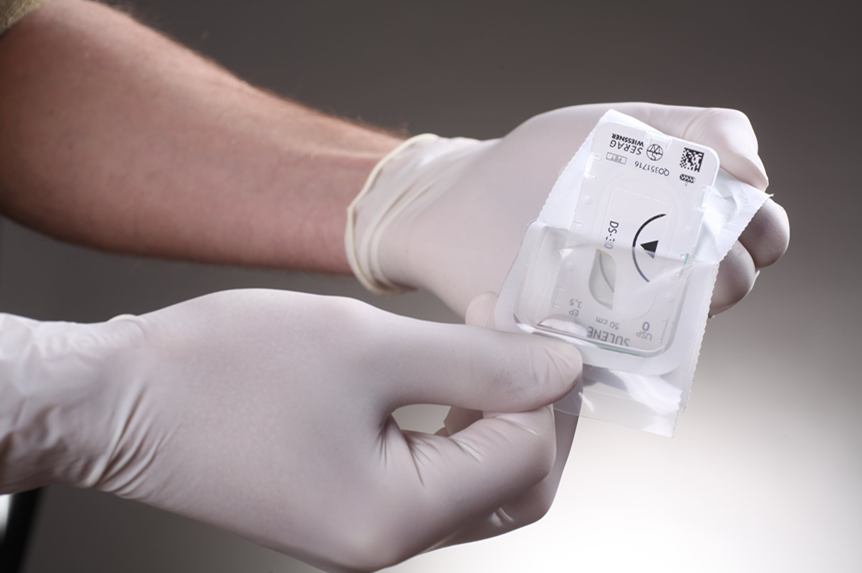
Sarung tangan steril mempunyai sampul luar yang melidungi kelonsong dalam yang steril. Jika melakukan tugas bersendirian, buka sepenuhnya sampul ini dahulu diatas permukaan yang rata dan mencukupi besarnya sebelum mencuci tangan. Jika ada pembantu, ia perlu memasukkan kelonsong dalaman tersebut kedalam medan steril.
Cara Mumbuka Bungkusan Sarung Tangan
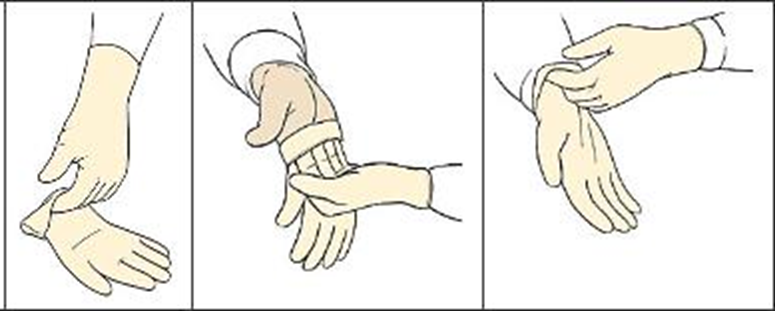
Apabila kelonsong dibuka sepenuhnya, bahagian pergelangan (pangkal) sarung sedia terlipat dengan keadaan bahagian dalamnya dibalikkan keluar. Untuk memakai sarung, gunakan jari telujuk dan ibu jari sebelah tangan (biasanya sebelah kanan) untuk memegang bahagian dalam pangkal sarung yang hendak dipakaikan pada tangan yang bertentangan (biasanya sebelah kiri)
Cara Memakai Sarung Pertama
Masukkan jari dan tapak tangan yang hendak dipakaikan sarung (biasanya kiri) sambil menarik kuat pergelangan sarung dengan jari telujuk dan ibu jari yang bertentangan (kanan) tadi. Biarkan pergelangan itu dalam keadaan berlipat. Bahagian yang disentuh dengan jari tadi dianggap tidak lagi steril tetapi bahagian hujung yang tidak disentuh masih steril.
Masukan empat jari (kecuali ibu jari) tangan yang telah disarungkan (kanan) ke celah lipatan pergelangan sarung yang satu lagi (kiri). Bengkokkan jari dan pegang sarung tersebut diudara.
Cara Memakai Sarung Kedua
Masukkan tangan yang belum disarung kedalam sarung tangan itu. Cekau dan tarik pergelangannya dengan kuat. Lepaskan cekauan supaya pangkal sarung terletak di atas pergelangan tangan.
Buka lipatan dan terbalikkan pangkal sarung itu.
Selepas kedua sarung telah terpakai, kutil bahagian hujung sarung yang pertama (kanan) yang masih terlipat dan tarik hingga tertutup sepenuhnya. Kemudian, elokkkan keadaan sarung supaya sendat pada jari dan meliputi semua bahagian tangan hingga ke pergelangan tangan.
Bila sarung telah dipakai elakkan dari menyentuh apa jua benda dan permukaan yang tidak steril. Sentiasa beringat bahawa kulit pesakit (walaupun telah dicuci tidak steril).
Jika sarung berlubang, koyak atau tercemar, gantikannya segera.
Teknik Tidak Menyentuh
Organisma mikro terutama bakteria berada dimerata tempat dipersekitaran termasuk diudara. Kehadirannya diudara dipersekitaran fasiliti perkhidmatan kesihatan bergantung kepada:
kebersihan bilik dan perkakasan didalamnya
penapisan udara
pertukaran udara (udara lama dengan udara segar)
pergerakan udara (dari tempat yang bersih ketempat kotor atau sebaliknya)
Di persekitaran klinikal kepekatan (bilangan) organisama didalam udara tersangat rendah. Ini adalah kerana udara yang masuk kekawasa klinikal ditapis dan dialirkan supaya sentiasa berganti. Oleh itu, pendedahan barangan kepada udara dalam masa singakat tidak dianggap sebagi pencemaran dan barangan tersebut tidak dianggap kesterilannya telah hilang.
Sebaliknya, sentuhan dengan sebarang objek lain yang tidak steril menjadikan peralatan steril menjadi tidak steril lagi. Dengan itu, pendekatan yang paling berkesan untuk mengekalkan steriliti ialah ‘teknik tidak menyentuh’. Asas kaedah ini ialah penciptaan proses kerja yang memastikan benda yang steril atau telah disucikan tidak bersentuhan dengan sebarang benda yang tidak steril. Ianya tercapai denan mengkaji keaadaan dan langkah (semasa membuat kerja) yang mungkin menyebabkan pencemaran melalui sentuhan dan menghindarkannya dari berlaku.
Mengurangkan Bilangan Organisma Mikro Pada Tubuh Pesakit
Kulit pesakit didiami oleh bakteria sedia ada atau asal. Kepesatan bilangan bakteria bergantung kepada bahagian tubuh berkenaan. Secara umum bakteria yang lumrah ialah Staphylococus epidermidis tetapi di bahagian punggung kerapkali terdapat spesis Escherichia coli. Penghuni tetap ini tidak merbahaya ketika dipermukaan tetapi boleh mengakibatkan penyakit serius jika masuk kesaluran darah dan melaluinya ketempat yang jauh seperti injab jantung, laluan air kencing, sistem aliran biliari, paru-paru atau otak. Sebaik sahaja seseorang dimasukkan kehospital, kulit mereka dihinggapi dan didiami oleh bakteria dari persekitaran hospital seperti spesis Staphylococcus aureus yang kahar. Kulit pesakit tidak boleh disterilkan. Namun bilangan bakteria boleh dikurangkan denagan menggunakan antiseptik seperti Povidone iodine, Alkohol 70% , Chlorhexidene 1:200 atau ramuan campuran kimia tersebut.
Ketika membuat prosedur invasif, peralatan akan terkena atau menembusi permukaan tubuh pesakit ia-itu samada kulit atau selaput mukosa. Kulit pesakit didiami oleh bakteria dan fungi sediada (contohnya Staphylococus epidermidis), yang asalnya tidak berbahaya tetapi boleh meyebabkan jangkitan melalui saluran darah ke organ lain seperti injab jantung, saliran air kencing, saluran biliari, paru paru atau otak. Kulit, hidung dan tekak pesakit yang menginap dihospital akan di dihinggapi oleh bakteria dari persekitaran hospital dengan kadar yang agak cepat. Sesestengah bakteria ini seperti Staphylococcus aureus adalah dari jenis yang lebih berbisa dan kebal dari yang berasal dikomuniti.
Pensucian Permukaan Kulit & Mukosa Sebelum Melakukan Prosedur
Kulit pesakit tidak boleh disterilkan tetapi bilangan bakteria boleh dikurangkan dengan menggunakan antiseptik seperti Povidone iodine, alkohol 70%, Chlorhexidene 1:200 atau campuran bahan kimia ini.
Permukaan lain seperti selaput mukosa mulut, tekak, hidung, faraj didiami oleh kumpulan bakteria tersendiri; jadi antiseptik yang sesuai perlu digunakan.
Mewujudkan Medan Steril
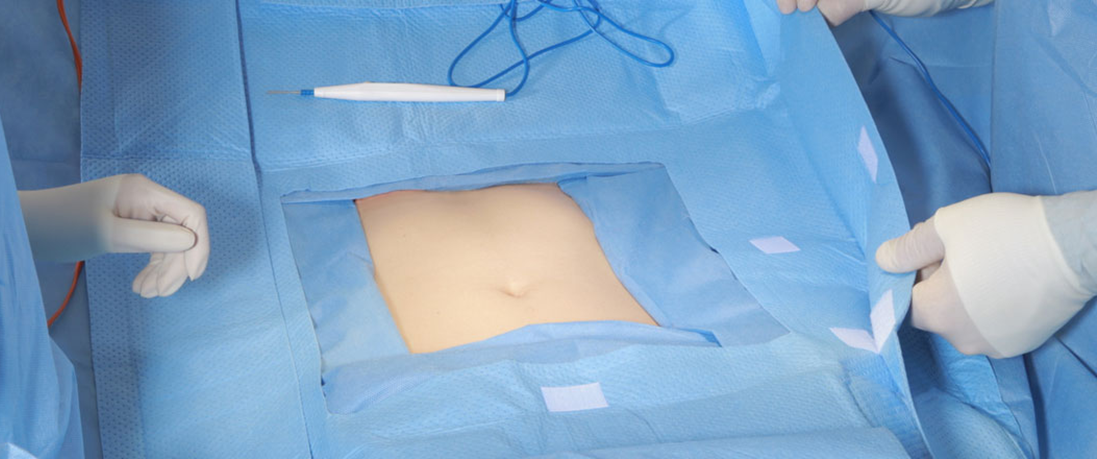
Semasa melakukan sebarang prosedur, satu kawasan khas yang dipanggil “medan steril” perlu diwujudkan. Ia bertujuan untuk mengelakkan perlatan steril dicemari oleh organisma mikro melalui sentuhan dengan benda lain yang tidak steril seperti:
tubuh pesakit
badan petugas
alatan tidak steril
perkakasan
cecair badan
Keluasan medan seteril hendaklah cukup untuk meletakkan semua perlatan yang perlu diatas permukaannya dan memberi ruang untuk petugas melakukan tugasnya. Medan steril diadakan dengan dua cara utama:
melapik permukaan troli dengan fabrik atau kertas steril
mengalas badan dan tempat baringan pesakit dengan kain atau fabrik sintetik steril
Mengikut kebiasaan, satu set steril dibuka sepenuhnya supaya pembungkus bahagian dalam melingkupi keseluruhan troli dan menjadi permukaan untuk bekerja. Perlatan steril tidak dibiarkan terjulur keluar dari medan steril. Hanya barang steril yang perlu sahaja boleh dimasukkan kedalam medan tersebut dan benda yang tidak steril perlu dihindarkan dari memasuki atau mendekatinya.
Pencemaran medan steril akan menyebabkan peralatan didalamnya menjadi tidak steril. Jika petugas memakai gaun steril, tubuhnya boleh menyentuh permukaan medan steril, tetapi jika ia memakai sarung tangan sahaja, ia tidak dibenarkan berbuat demikian.
Menggunaan Peralatan Dan Bahan Lain Yang Steril
Semua peralatan yang digunakan semasa melakukan prosedur invasif perlu bebas dari organisma mikro. Pensterilan menghapuskan semua jenis organisma mikro termasuk spora.
Peralatan dan bahan pakai buang lain, yang dibeli dari pembekal, sudah disterilkan dengan menggunakan gas Ethylene oxide atau atau Radiasi Gamma dan diletakkan dalam bungkusan steril.
Peralatan yang dipakai semula disterilkan dengan wap bersuhu tinggi (autoklaf) atau bahan kimia (Ethylene oxide etc.) di Unit Pensterilan Hospital. Kaedah yang sama juga boleh digunakan untuk bahan pakai buang yang belum steril seperti kain pembalut.
Sesetengah peralatan seperti endoskop terbuat dari bahan yang tidak boleh terdedah kepada suhu tinggi. Kaedah pensterilan dengan suhu rendah seperti kaedah pensterilan plasma (contohnya SterradTM) atau menggunakan disinfektan tahap tinggi dengan larutan kimia disinfektan seperti Glutaraldehyde (CidexTM), Gigasept and Peracetic acid.
Pensuciaan
Pensucian tahap tinggi menhilangkan semua bakteria dan virus and sebahagian besar spor (kecuali sesetengah bakteria seperti Mycobacterium tuberculosis). Untuk kaedah ini perlatan direndam dalam larutan disinfektan tahap tinggi sebelum sahaja prosedur dilakukan dan bukan sehari atau lebih. Biasanya pensucian tahap tinggi digunakan untuk endoskop termasuklah bronkoskop, sistoskop, ureteroskop, and histeroskop.
Pensterilan endoskop boleh juga dilakukan dengan kaedah penstrilan suhu rendah. Cara ini membolehkan alat dibungkus dan sterilitinya dikekalkan. Kalau kaedah ini dipakai beberapa endoskop diperlukan. Rujukan:
Jika medan steril tercemar segala peralatan didalamnya juka akan tercemar. Jika petugas hanya memakai sarung tangan steril tetapi tidak memakai gaun steril, tubuhnya tidak boleh menyentuh sempadan medan steril. Sebaliknya, jika gaun steril dipakai, bahagian tubuh yang ditutup dibenarkan menyentuh medan steril. Pastikan perlatan steril tidak terkeluar melampaui medan steril dan barang yang tidak steril tidak memasuki medan steril.
Teknik tidak menyentuh memastikan peralatan dan perkasan lain kekal steril semasa prosedur dijalankan. Bila membuka sampul atau bungkusan petugas mestilah memastikan permukaan dalamnya tidak disentuh.
Membuka Bungkusan Steril Tanpa Menyentuh Barang Didalam
Pindahkan barang didalamnya dengan menjatuhkannya kedalam medan steril atau dengan mengambilnya dengan tangan yang memekai sarung tangan steril atau alat penyepit yang steril tanpa meneyentuh bahagian luar pembungkus yang tidak steril. Untuk tujuan ini sesetengah barang dibungkus berganda supaya bungkusan didalam steril keseluruhanya.
Pembungkusan Berganda
Selepas dipaindahkan kesemua peralatan dan bahan steril lain sepatutnya kekal didalam medan steril. Peralatan yang tercemar perlu diasingkan atau dukeluarkan dari medan steril.
Jika peralatn tidak steril perlu digunakan didalam medan steril, sarung steril kain atu plastik lut sinar perlu digunakan untuk menutupnya (prob ultrasound, mikroskop, tumbul atau swic alatan elektronik).
Memastikan Peralatan Steril Tidak Tercemar Semasa Diangkut Dan Disimpan
Kesterilan barangan yang steril dikekalkan dengan membungkus dalam sampul, pembungkus atau bekas tertutup. Ia kekal steril jika:
bungkusan itu tidak terbuka atau pecah
ia dibuka dengan betul dan dimasukkan kedalam kawasan steril sebelum digunakan
selepas bungkusan atau set dibuka perlaan sentiasa berada didalam medan steril
diawas supaya tidak tercemar semasa digunakan
Semasa diangkut atau disimpan kesterilan boleh hilang jika:
bungkusan itu koyak atau bocor
telah diresapi cecair
bungkusan atau bekas terbuka dengan tidak sengaja
Barangan tersebut tidak boleh digunakan. Ia perlu disterilkan semula.
Semasa diangkut, barangan perlu diletak dalam kotak bertutup dan troli khas digunakan. Tempat simpanan perlu disimapan bersih, tidak digangu serangga atau tikus dan jauh dari tempiasan air.
Memastikan Larutan Antiseptik Sentiasa Bebas dari Organisma Mikro
Kepekatan cecair antiseptik mestilah mencukupi untuk membunuh kuman dan tidak dicairkan sehingga tidak lagi berkesan (misalnya cecair Chlorohexidine 1: 2000 terlalu cair dan tidak berkesan). Tarikh luput larutan perlu tertera pada bekasnya. ‘Ujian (C&S) semasa diguna’ perlu dibuat dari masa kesemasa.
Jika larutan (seperti bahan pelincir, povidone iodine) boleh diletakan dalam bekas kecil yang steril ia perlu disampulkan didalam sampul krdua yang luarnya tidak steril. Jika tidak, cecair perlu dilepaskan secara terus dari bekasnya tanpa meleleh, kerana bahagian luar bekas tersebut tidak steril.
AMALAN TEKNIK ASEPTIK PADA PELBAGAI SITUASI
Teknik aseptik digunapakai untuk melakukan pelbagai prosedur dalam berbagai keadaan. Dengan itu, ia boleh diubahsuai selagi segala prinsip asas dituruti.
Prosedur Ketika Melakukan Prosedur Bersendirian
Bila melekukan sesuatu prosedur bersendirian, petugas perlu melakukan proses yang tidak memerlukan tangan yang steril dahulu sebelum memakai sarung tangan steril. Contohnya, ketika menyediakan set serta peralatan untuk melakukan prosedur, arahan kerja berikut perlu diikuti:
Buka set untuk mewujudkan medan steril,
Letakkan perlatan dan larutan yang perlu kedalamnya.
Buka sampul luar sarong tangan steril sepenuhnya sebelum membasuh tangan.
Jika satu tangan diperlukan untuk meyentuh benda atau permukaan yang tidak steril tentukan tangan yang akan tercemar dan pastikan sebelah tangan yang hendak digunakan untuk melakukan prosedur steril sentiasa kekal steril. Situasi dimana keadah ini lazim digunakan termasuklah:
Menaruh tiub saliran air kencing
Menyedut saluran trakea yang dipasang trakesostomi
Memasing dan menanggalkan sambungan tiub aliran intravena
Memasang Tiub Saliran Air Kencing
Memasukkan tiub ke pundi kencing melalui saluran urethra perlu dibuat mengikut kaedah berikut:
Cuci tangan dan keringkan
Buka set steril untuk tujuan ini untuk mewujudkan medan steril
Masukkan larutan antiseptik (chlrohexidine atau cetrimide)
Masukkan kateter sterile kedalam medan steril
Pakai sarung tangan steril
Cucu keseluruhan faraj atau zakar dengan larutan antiseptik
Letakkan kain steril didepan faraj atau bawah zakar
Pisahkan labia minora atau locehkan kulit zakar dengan tangan yang tidak dominan (biasanya kiri)
Cuci pembukaan urethra dengan swab kapas dicelup dalam antiseptik
Dengan tangan kanan, gunakan penyepit untuk memegang bahagian hujung kateter dan masukkan hujung kateter kedalam saluran urethra hingga air kencing keluar
Kalau tiada air kencing keluar tekan bahagian supra-pubik sehingga kencing keluar.
Gelembungkan belon kateter dengan memasukkan 5-10 ml air steril
Bukakan bungkusan set saliran dan beg untuk mengumpul air kencing.
Pegang tiub saliran sambil memastikan hujungnya kekal steril
Pegang bahagian penghujung luar kateter, masukkan penghujung tiub saliran dengan kaedah tidak menyentuh dan ketatkan
Gantungkan beg penadah kencing dengan alat penggantung atau tali.
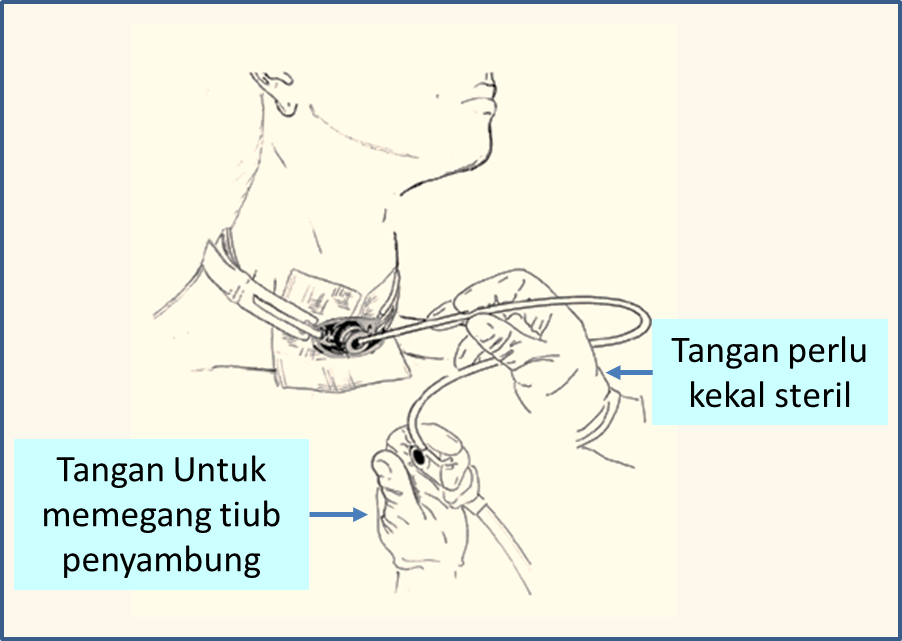
Melakukan Sedutan Larynx Kepada Pesakit Dipasang Trakeostomi
Pegang bahagian tiub kateter gahagian yang tidak steril dengan tangan kiri dan bahagian hujung yang steril dengan tangan kanan.
Kaedah Meyedut Trakeostomi
Membuka dan Memasang Semula Kanula Intravena/Arteri Yang Sedia Terpasang
Pencemaran kanula dan tiub yang dimasukkan kedalam saluran darah boleh menyebabkan sepsis pembiakan bakteria padanya dan jangkitan yang menular kedalam darah pesakit. Kejadian ini boleh dikurangkan jika kanula dibiar dalam saluran darah untuk tempoh yang singkat ( > 48 jam). Penggunaan saluran intravena sentral (central lines), saluran vena femoral dan saluran arteri dan vena umbilical menempah risiko lebih tinggi berlakunya sepsis sistemik atau jankitan pada organ lain. In neonates, a possible distressing complication is septic arthritis and osteomyelitis at the metaphyses.
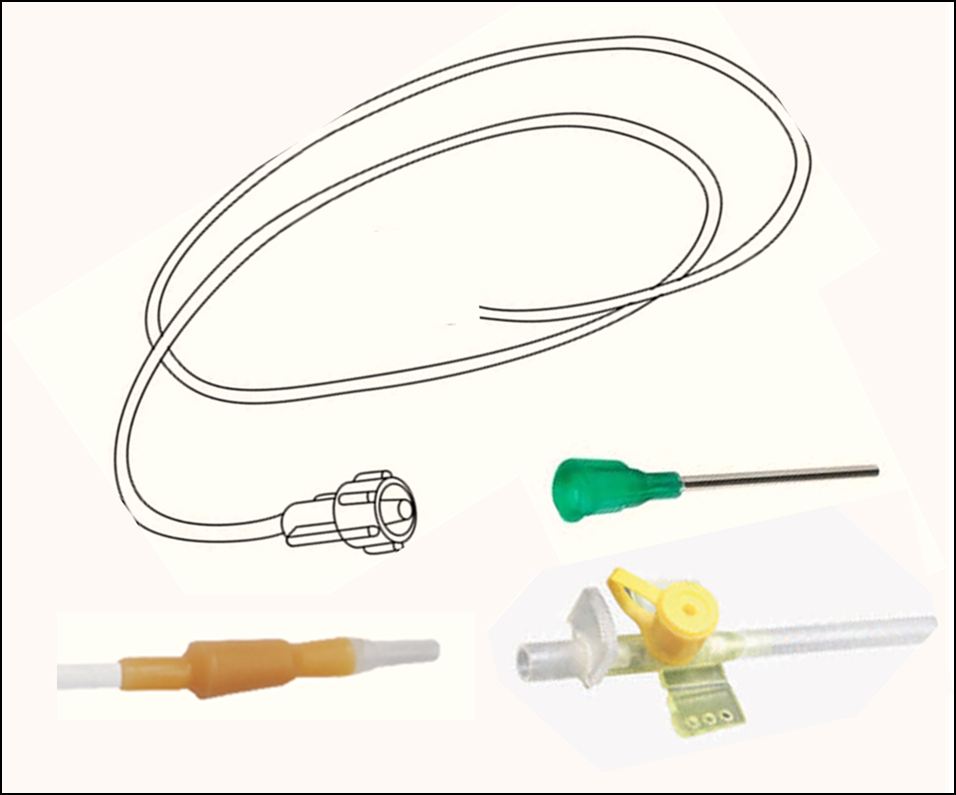
Sambungannya berbentuk “Luer lock” atau biasa. Sambungan Luer lock mempunyai bentuk dimana hujung tiub saliran merupakan penyambung “jantan” dan pangkal kanula berbentuk “betina”. Terdapat pengadang di hujung tube supaya ia kekal steril.
Hujung Tiub Aliran IV dan Kanula Yang Dibuka/sambung
Semasa membuka dan menyambung Tiub aliran IV ke kanula, perhatin perlu diberi supaya penghujung tiub dan bahagian dalam kanula intravena kekal steril. Ia boleh dibuat dengan dua cara:
Memberikannya kepada petugas kedua supaya memegang tiub pada bahagian tidak jauh dari penghujung itu (pesakit yang faham tentang proses ini boleh diberi tugas ini)
Dengan menggantungkan tiub di penyakut drip tanpa membiarkannya menyentuh apa apa.Tutup kanula dengan siring atau penutup (stopper).
Letakkan stopper atau jarum bertutup (yang berfungsi sebagai stopper) pada hujung tiub aliran pada Leur Lock.
Pentup Hujung Tiub dan Pangkal Kanula (Stopper)
Penggunaan Stopper atau Jarum Untuk Menutup Hujung Tiub Aliran
Untuk menyambung semula, buang spigot atau jarum bertutup (yang berfunsi sebagai spigot) dari hujung tiub aliran. Kemudian pegang pangkal kanula denagn kemas dan pusing semula sambungan Leur Lock pada penghujung tiub kedalam pangkal kanula.
Sebenarnya, adalah agak sukar untuk menhindarkan pencemaran ketika melakukan prosedur ini jika dibuat oleh seorang petugas sahaja. Hasilnya adalah lebih baik jika ia dilakukan oleh dua orang petugas.
Melakukan Prosedur Dengan Bantuan Petugas Lain
Untuk mengekalkan asepsis, kebanyakan proedur memerlukan pembabitan dua petugas: seorang atau lebih untuk melakukan prosedur didalam medan steril dan seorang pembantu untuk melakukan proses diluar medan steril.
Amalan teknik aseptik untuk keadaan berkaitan dibincangkan dibawah.
Surgery – Minor and Major (operative team and circulating nurse)
Endoscopic therapeutic procedures (performer and assistant)
Endotracheal Intubation with an ET tube
The former performs direct laryngoscopy with a laryngoscope and identifies the glottis opening. The assistant should open the sterile pack of the ETT fully. The performer picks the external end of the tube and inserts the internal end directly into the trachea without touching structures in the mouth and throat (nor should he/she bend the tube on the bare OT table!). If for any reason the ETT tube need to be put down, place it back onto the sterile package looked after by the assistant.
Memasukkan Saluran Intravena Sentral (pelaku dan pembantu)
The assistant introduces the IV cannula and all connecting tubes into the sterile field. Before the performer has inserted the cannula, he/she passes the end of the intravenous tubing (used to puncture the IV solution bag) to the assistant. The assistant connects the tubing to the bag and the fluid is run in to prime the line. The other end remains sterile in the sterile field and the performer then connects it to the intravenous cannula that has been inserted.
Inserting Chest Drains, Peritoneal Dialysis Catheter and Urinary Catheter
The assistant places all tubes and containers into the sterile field using a non-touch technique. The person inserting the tube should secure the connections before passing the containers (underwater seal bottles / urine containers / dialysate bags) to the assistant. Problems arise when the sterile catheter or tubes need to be connected to connectors outside of the sterile zone. In that situation the sterile (female) end is passed over to the assistant who will then connect it to the (male) connecter which has been kept sterile.
Menyedut Lendir Trakea-Bronkial pada Pesakit Yang Disampung Ke Mesin Pernafasan Melalui Tiub ETT atau Trakeostomi
Dalam situasi ini teknik aseptik memerlukan dua petugas. Seorang petugas membuka dan menyambung semula tiub sambungan dari mesin ke ETT/Trakeostomi sambil menyambungnya ke Ambu dari masa kemasa.
Petugas yang seorang lagi yang melakukan sedutan memakai sarung tangan sambil memastikan tangan dan tiub penyedut kekal steril.
Bahagian Tiub Steril dan Tidak Steril
Kaedah Menyedut Tiub Intratracheal
When Delivering Babies
The risk of puerperal sepsis is always present (as was at the time of Semmelweis 1847 Ref: http://en.wikipedia.org/wiki/Semmelweis). Normal spontaneous delivery may be performed by one obstetrician or midwife but for instrumental delivery (vacuum extraction or forceps) at least two persons is required. The instrument pack when opened should cover a whole trolley and more. The skin of the perineum and groin need to be cleaned with Cetrimide 3% or Chlrohexidine aqueous 1:200. Ref: http://en.wikipedia.org/wiki/Cetrimide. The obstetrician should wear a sterile gown. He/she need to drape the patient with sterile sheets exposing only the perineum and the introitus.
Managing the baby (resuscitation and so on) should be a separate procedure from the delivery itself.
Performing Wound Toilet & Dressing.
It is customary to name the two parties as clean nurse and dirty nurse. Perhaps it is better to call them inside nurse and outside nurse i.e. in and out with regards the sterile field.
The outside nurse opens the outer covering of the dressing set.
The inside nurse washes her hand and wears a pair of sterile gloves. She opens the inside layer of wrapper using her hands or the forceps provided.
The outside nurse now drops gauze pieces, cotton swabs, syringe and scissors into the sterile field created and after which she pours lotions into the galley pots. She then proceeds to remove the existing outer dressing on the wound.
The inside nurse should remove dressings within the wound with a pair of sterile forceps which she then passes outside. She then cleans the skin around the wound with 70% Alcohol or Chlorohexidine. The edge and base of the wound is cleaned with Chlorohexidine 1:200 solution. If MRSA is present Povidone iodine should be used and if it is Pseudomonas, it is customary to use Acetic acid. Sodium hypochlorite and hydrogen peroxide can be used for obviously infected wounds. The wound is flushed thoroughly with sterile saline or water using a syringe.
At the early stage of wound care gauze soaked in suitable antiseptic mentioned earlier or proprietary wound filler impregnated with antiseptic can be left inside the wound. Dry gauze or proprietary dressing is used for the external dressing and fixed with any type of plaster or a transparent dressing cover can be used.
When the wound is rid of infection then gauze moistened with saline or plain proprietary dressing is used. Otherwise, no gauze is placed in the wound but a roof of foam dressing or adhesive plastic is placed over the wound and left untouched for two or more days.
Managing traumatic and surgical wounds
Where a site already has resident bacteria (i.e. nose, external ear, throat, vagina), or is an infected wound; it is also important to follow (albeit a less strict) aseptic technique in order to prevent the introduction of other more virulent organisms especially the usual hospital resident species such as Multiresistant Staphlococcus aureus, Pseudomonas aerogenosa, Klebsiella pneumonia, Acinetobacter and Extended spectrum beta-lactamase producing organisms (ESBL)
Penggunaan Spekulum & Endoskop pada Rongga Badan yang Jangkat
Rongga badan seperti mulut, hidung, tekak, faraj dan dubur mengandungi bakteria namun alat yang dimasukkan kedalamnya untuk tujuan pemerhatian perlu dicuci tetapi tidak semestinya disterilkan. Pencucuan boleh dibuat dengan disinfektan seperti glutaraldehyde [CidexTM], 70% Alcohol, Gigasept, Peracetic acid, Formaldehyde, Trigene, Sodium hypochlorite. Selepas dicuci, alatan tersebut perlu disimpan ditempat yang bersih dan dielakkan dari tercemar seperti tersentuh dengan tangan yang tidak dibasu atau permukaan yang kotor.
RUMUSAN
Amalan teknik aseptik memerlukan pemahaman tentang prinsip yang berkenaan, pematuhan kepada prosedur yang betul, keperluan yang sesuai serata mencukupi, dan persekitaran yang sesuai. Teknik yang betul memerlukan penumpuan, sikap berjagajaga, keperhatinan dan penyeliaan.









 Where Are We Going To
Leave a comment